Gaining weight is easy. But gaining mostly muscle — that's where the real work begins. In the Anatoly Fit system, weight gain is viewed as a controlled phase, not as an excuse to eat whatever comes your way. Extra calories can support more intense workouts, recovery, and muscle growth. However, the body cannot convert an unlimited surplus of calories into an unlimited amount of new tissue.
The key question isn’t whether you should eat more, but how much more: where does a productive calorie surplus end and excess fat gain begin?
Lean Bulk vs. Dirty Bulk: What’s the Real Difference?
The point isn't which foods are “good” and which are “bad”. It's all about control. With “clean bulking,” you maintain a moderate calorie surplus and track your body weight, waist circumference, and workout results. With “dirty bulking,” the calorie intake is increased, but often no attention is paid to how quickly weight is gained.
Eating more food doesn't automatically mean more muscle gain. If your training, protein intake, and recovery are already on point, a calorie surplus may simply lead to fat gain. This doesn't promote anabolism.
| Approach | Lean bulk | Dirty bulk |
|---|---|---|
| Surplus | Moderate | Large |
| Weight gain | Slow | Faster |
| Food choices | Structured | Less controlled |
| Fat gain risk | Lower | Higher |
| Tracking | Regular | Minimal |
The goal is to gain weight at a controlled pace. Such a pace should support training and allow you to adjust the regimen before fat gain begins.
How Big Should Your Calorie Surplus Be?
For an experienced athlete, the calorie surplus should not be too large. A practical starting range is approximately 5–10% above the level needed to maintain weight. If the level needed to maintain weight is 2,500 kcal, that means approximately 2,625–2,750 kcal per day.
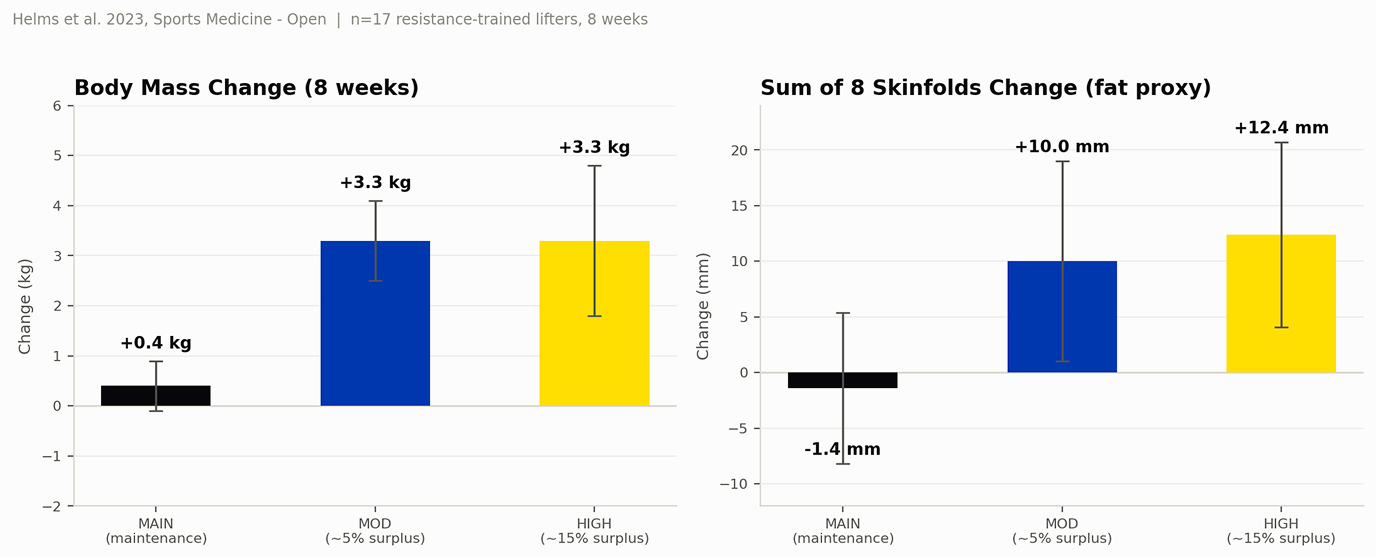
In a study by the Sport Performance Research Institute of New Zealand, conducted among individuals who engage in strength training. A weight-maintenance diet was compared with diets featuring a planned caloric surplus of approximately 5% and 15%. After eight weeks, the faster weight gain showed a much clearer association with an increase in skinfold thickness than with additional muscle growth. Higher calorie intake did not lead to a corresponding increase in muscle hypertrophy.
This initial value should be considered a starting point, not a permanent target. Stick to it for two to three weeks, monitor your average body weight and your gym results, and then gradually adjust it. Building muscle mass without gaining fat requires maintaining a sufficient calorie surplus for muscle growth, without treating every extra kilogram on the scale as progress.
How Do You Calculate Macros for a Lean Bulk?
The macro calculation should start with your total calorie intake, not with protein shakes. First, roughly estimate the number of calories needed to maintain your weight, and add your planned calorie surplus to that. Then, determine your protein intake, ensure you’re getting enough fat for a balanced diet, and fill the remaining calories with carbohydrates.
For muscle gain, the practical recommended daily protein intake is approximately 1.6–2.2 grams per kilogram of body weight. More isn’t always better: studies show that the additional benefit for muscle growth becomes negligible once total intake is already sufficient.
Let’s take, for example, an athlete weighing 80 kg who consumes 2,700 kcal. At a recommended intake of 2 g/kg, protein provides 160 g, or 640 kcal. If fat intake is 75 g, that adds 675 kcal. The remaining 1,385 kcal can come from carbohydrates — approximately 345 g. These carbohydrates are not just “filler”: they help maintain training volume and support recovery.
These numbers are a starting point. If your weight and results haven't changed after a few weeks, start by adjusting your calorie intake rather than constantly changing your entire macronutrient breakdown.
Does Bulking Change the Way You Should Train?
Mass gain shouldn't be a reason to add endless sets. Extra energy can aid recovery, but the signal for growth still comes from resistance exercises. A recent review in the field of physiology describes strength training as the primary external factor in hypertrophy, while nutrition plays a supporting role.
This is in line with Vladimir Shmondenko's training philosophy:
Squats, presses, deadlifts, and other compound exercises should remain the foundation of the workout.
Gradually increase the weight, the number of repetitions, or the number of working sets.
Use auxiliary exercises to address weaknesses, not to cause additional fatigue.
For hypertrophy training while gaining muscle mass, progression is more beneficial than a haphazard increase in volume. If your recovery improves, use that to perform high-quality work more consistently, rather than simply extending the duration of each workout.
Do You Need a Weight Gainer or Other Mass Gain Supplements?
A weight gainer is most useful when it becomes difficult to consume enough calories. On its own, it does not stimulate additional muscle growth; it simply makes it easier to achieve a daily calorie surplus. Protein powder works the same way: it’s a convenient nutritional supplement, not a necessity.
Among mass gain supplements, creatine monohydrate has by far the most compelling scientific evidence. A recent meta-analysis showed that adding creatine to strength training increased lean body mass by approximately 1.14 kg compared to training without it.
The practical recommendations are simple:
First of all, make sure your body gets enough calories and protein;
Use a weight gainer only for convenience;
Consider supplements as a supporting tool, not the foundation for gaining mass.
Its purpose is to make it easier to stick to a diet. This doesn't mean you have to completely replace meals with powders and shakes.
How Can You Tell If Your Bulk Is Actually Working?
The number on the scale alone isn’t a sufficient indicator of a successful lean bulk. What matters is whether the additional body weight is accompanied by improved workout results and controlled changes in body composition.
Track several metrics at the same time:
Average weekly body weight, rather than daily fluctuations.
Waist circumference measurements taken under consistent conditions.
Progress in the number of repetitions, load, or total volume of work.
Photos or body measurements taken every few weeks.
When your weight and gym results aren't changing, try eating a little more. But if your weight is rising quickly and your waistline is getting bigger too, you might be getting too many calories.
Anatoly takes the same approach to gaining muscle mass: track your progress at the gym, not just the numbers on the scale.
Bulk With a Target, Not Just More Food
Lean bulking yields the best results when the calorie surplus serves a specific purpose: supporting workouts, recovery, and steady muscle mass gain without causing body fat to increase too rapidly.
The Anatoly Fit program is based precisely on this logic:
Eat as much as you need to make progress;
Track your progress regularly;
Adjust your diet when your results no longer align with your goals.
This is exactly what helps those who are bulking up to focus on their progress, rather than just on gaining weight.
FAQ
How fast should body weight rise during a lean bulk?
Quite slowly. For most people who exercise regularly, a small weekly increase in intensity is easier to manage. Plus, it gives you more time to notice any unwanted fat gain.
Do I need to count every calorie?
Not always. But when building muscle mass, it’s helpful to keep track of your progress in some way. Even a rough food diary and an average weekly weight can show whether your intake is heading in the right direction.
When should I stop taking a weight gainer?
When fat gain begins to outweigh the positive results, your training progress stalls for a long time, or you simply reach your target weight.
Should calories be lower on rest days?
That's possible, but it's not necessarily the case. What matters more is the average weekly consumption and whether recovery remains at the appropriate level.
Subscribe for Updates
By signing up for our newsletter, you agree to the terms outlined in our privacy policy. You can unsubscribe at any time.