A deadlift can be ruined even before the plates have moved even a centimeter. If the barbell remains pressed against the floor, a powerful extension will never have a chance to show its full potential.
Vladimir Shmondenko, an athlete known for the Anatoly Fit brand. He set a personal record of 320 kg in the deadlift. And he did this while weighing 78 kg. No single variation of the exercise can claim credit for achieving this result. The more useful lesson lies elsewhere: strength in the initial phase deserves a dedicated workout.
What Is a Deficit Deadlift?
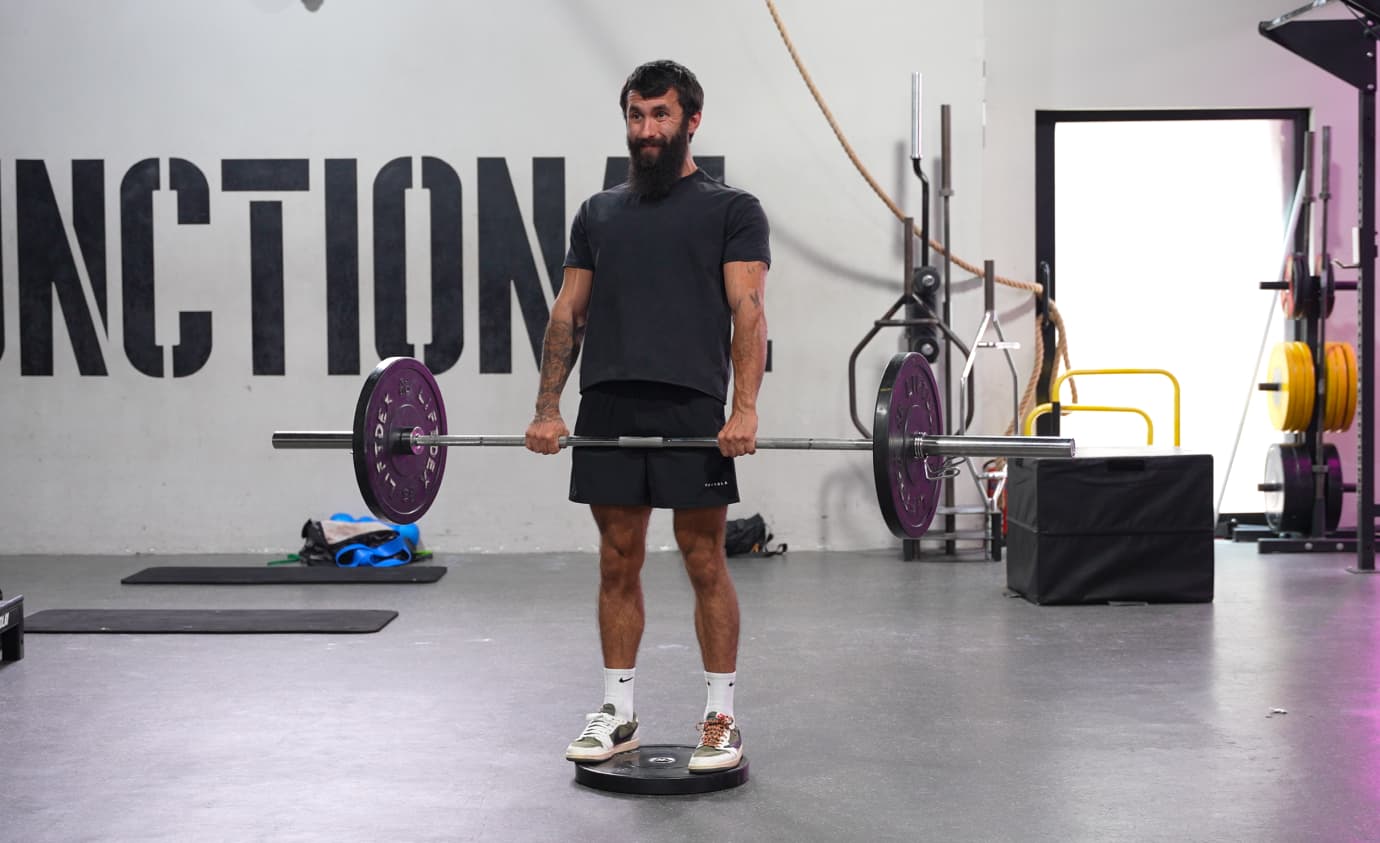
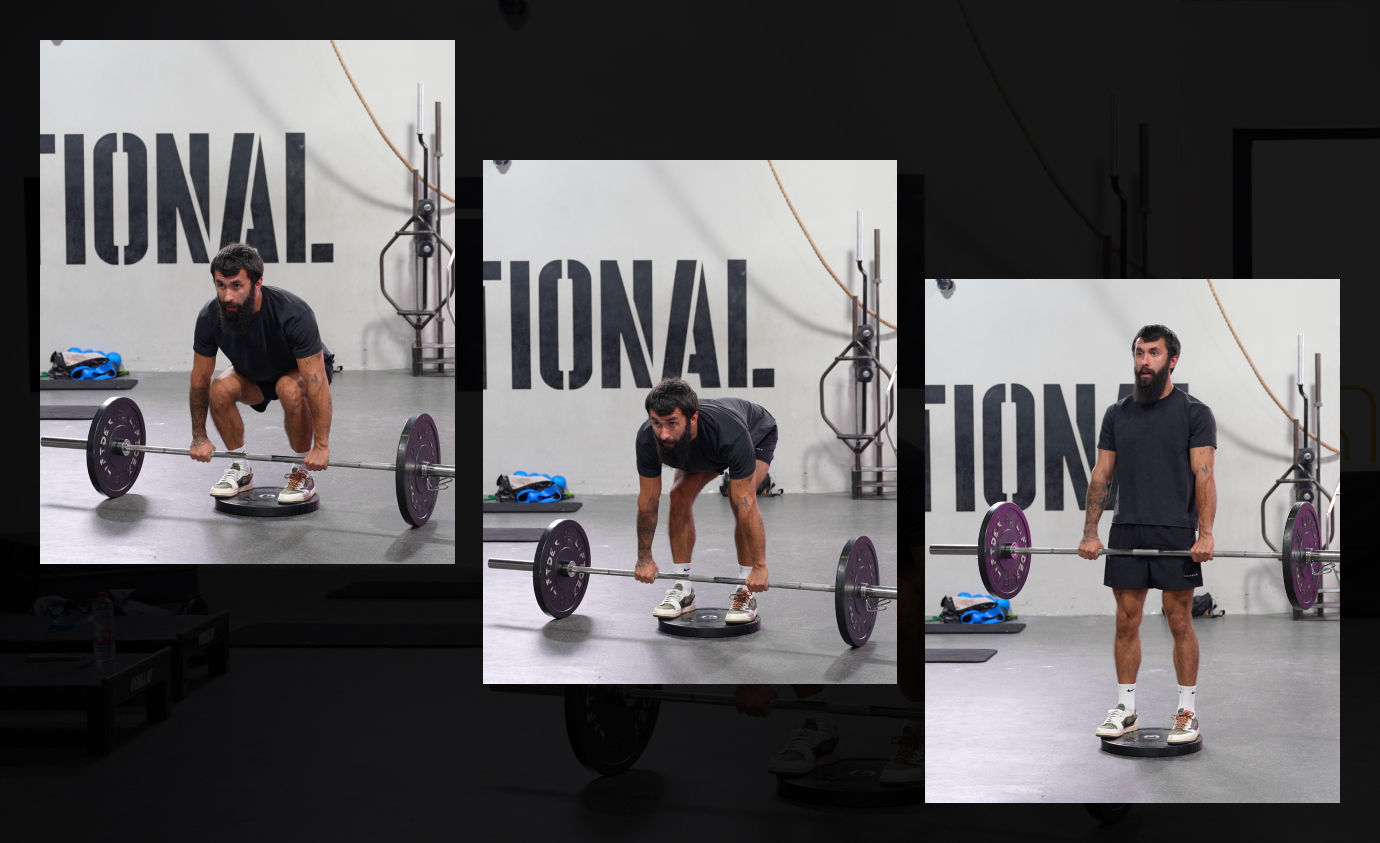
A deficit deadlift is a barbell deadlift performed while standing on a stable, elevated surface. The barbell remains on the floor in front of the shins, but the athlete begins the movement slightly deeper/lower than usual. This increases the distance the barbell must travel, places the body in a deeper starting position, and provides a greater range of motion.
Unlike other deadlift variations, where the barbell is lifted and the range of motion is reduced, the deficit deadlift lengthens the initial phase. It's usually considered a supplementary option for athletes who struggle to build strength from the floor.
Feature - Conventional deadlift - Deficit deadlift:
Foot position - On the floor - On a raised platform or plate
Bar position - On the floor, in front of the shins - On the floor, in front of the shins
Starting position - Standard pulling height - Deeper because the feet are elevated
Range of motion - Standard - Increased
Typical role - Main deadlift movement - Accessory work for the initial pull
In informal descriptions of this technique, you may come across the term “platform deadlift,” although the term “deficit deadlift” is more accurate. The defining feature isn't a different barbell trajectory: it still moves in front of the body. The difference lies in the fact that the athlete stands above floor level and is forced to pull the barbell a greater distance.
Why Is It Called a Deficit Deadlift?
This term describes the technique used to perform the exercise rather than a distinct tradition in weightlifting. By standing above floor level while the barbell remains below, the athlete creates a vertical deficit and is forced to start from a deeper position. The exact height may vary, but the goal isn't to create as much of a gap as possible, but rather to make the initial movement more difficult without losing control of the barbell.
Why Does a Deeper Starting Position Change the Lift?
A deeper start changes the joint angles even before the weight begins to move. Greater flexion in the ankles, knees, and hips requires stable stabilization even before the athlete begins to use leg drive, and the weight must travel a greater distance. Two years ago, a study was conducted on this topic at a conference dedicated to the subject. It involved 20 athletes performing deadlifts in three variations:
Standard,
With a block,
With a 4-inch deficit.
The deficit resulted in a greater range of motion in the ankle, knee, hip, and trunk, as well as higher peak activity in the gluteal muscles and quadriceps compared to the other variations.
The experiment explored strength deficits when lifting a weight bar during a single training session. This doesn't apply to a specific version of the exercise or long-term 1RM gains. Therefore, a deeper pull is most relevant for off-the-floor strength. If the barbell reaches knee level before coming to a stop, this may indicate that the workout is targeting the wrong weak link.
How Should You Set Up a Deficit Deadlift?
Choose a firm, non-slip surface that is wide enough to accommodate both feet. It shouldn't wobble, sag, or slide under load. Start with the lowest elevation that noticeably lengthens your pull without forcing you to move out of a stable starting position.
Stand on the platform so that the barbell is positioned over the center of your feet.
Assume your usual deadlift stance and grip.
Bring your shins close to the barbell without pushing it forward.
Engage your core and eliminate any sag in the barbell before beginning the pull.
Perform the pull by pushing off the platform, keeping the barbell close to your body.
Lower the barbell in a controlled manner and return to the starting position before the next repetition.
This exercise isn't a test of strength. If your hips rise sharply, your back position changes, or the bar shifts, lower the height or go back to a standard deadlift.
Who Might Find This Useful, and Who Should Probably Hold Off?
This variation is suitable for an experienced athlete whose standard deadlift remains technically consistent but consistently slows down even before the barbell leaves the floor. In this case, there is a clearly defined weakness that needs to be addressed.
However, this is a poor choice when the technique for performing the basic deadlift varies from one repetition to the next, the platform shift, or the grip makes it impossible to achieve a reliable muscle contraction. Pain is a signal to stop, not a mobility challenge to be overcome.
This will also be ineffective when the actual point of resistance is in the knee area or at the end of the extension phase. Additional difficulty is only beneficial when it addresses the problem; otherwise, it merely adds fatigue.
Where the Exercise Fits in Anatoly’s Training Logic
In Vladimir Shmondenko’s training philosophy, heavy compound movements form the core of athletic development. Accessory variations like the deficit deadlift exist for one primary reason: to systematically eliminate technical sticking points in the main lifts.
A structured introduction to this exercise might look like:
One training session per week for three weeks;
3 sets of 4 reps with a Rate of Perceived Exertion (RPE) of 6–7, leaving approximately three quality reps in reserve;
Performed after moderate deadlift work or in place of another complex pulling exercise;
Don't add weight until every rep starts from the exact same position.
A 2025 meta-analysis, which included 43 studies and 1,660 participants, showed that strength gains were greater in dynamic exercises — which people actually performed during their workouts — than in untrained isometric tests. It didn't look at deficit deadlifts or how they translate to the conventional deadlift. Therefore, the practical conclusion is fairly cautious: keep the conventional deadlift in your program and only keep this variation if your start becomes noticeably cleaner or faster.
Only Use It When the Start Is the Weak Link
The deficit deadlift proves useful when the initial phase is the athlete's real weakness. Additional depth makes no sense if muscle tension or balance is lost.
According to the training logic of the Anatoly program, difficulty alone proves nothing. This exercise variation makes sense only if the athlete goes back to the traditional deadlift with a more powerful and stable start.
FAQ
Is the deficit deadlift the same as a Romanian deadlift?
No. The deficit deadlift starts with the barbell resting motionless on the floor and involves fully extending the legs at the lowest point of the lift. The Romanian deadlift starts from a high position and primarily targets the lowering and hip flexion phases.
Is a deficit deadlift harder than a regular deadlift?
That's usually the case when comparing the same load. A greater range of motion and a lower starting position leave less room for error, so deficit deadlifts are typically performed with lighter weights.
How high should the platforms be?
Just enough to increase the pull without altering the athlete’s muscle tension or balance. Greater depth doesn’t always mean greater effectiveness.
Should the deficit deadlift replace regular deadlifts?
No. According to the training philosophy followed by Anatoly, a particular exercise variation deserves a place in the program only when recorded results show that it contributes to improved performance in the main exercise.
Subscribe for Updates
By signing up for our newsletter, you agree to the terms outlined in our privacy policy. You can unsubscribe at any time.